
What To Do With A Problem Like Sciatica
In our last post we explained what sciatica actually is — pain along the path of the sciatic nerve — and the conditions that pretend to be sciatica but aren't. If you haven't read it, it's worth a look, because everything here starts from one idea: there's no single "sciatica treatment" that's right for everyone.
Two people can walk in with pain down the leg and need completely different plans. One might have a genuinely irritated nerve. Another might have a cranky hip or a tight, overworked buttock muscle doing a very convincing impression of sciatica. So before we treat anything, we assess. Once we know what we're dealing with, we can pull from a range of approaches — and because we've got a mixed team under one roof in Exmouth, we can usually match the treatment to the person rather than forcing the person to fit the treatment.
Here's how that looks in practice.
It Starts With A Proper Assessment
Every good plan begins with working out the real problem. We take a history, look at how you move, test the nerves and joints, and check the usual masqueraders — the hip, the sacroiliac joint, and the deep buttock muscles. We're also screening for the small number of red-flag symptoms that need onward referral rather than hands-on care.
Quick aside: We’ve had a couple of enquiries recently where potential new patients have asked if they can just walk in and “be clicked back into place”. The answer is always no, and the paragraph above is why. We take pride in doing a professional job and that’s not even anything special - just the minimum you should expect from a chiropractor.
Anyway, proper assessment is the step that can save people months of frustration. "Stubborn sciatica that won't shift" is very often a plan aimed at the wrong target. Get the target right, and the rest gets a lot easier.
Giving You The Map
We’ll provide you with a written report at your results appointment. This helps us and you to understand the prognosis and a realistic timeline for recovery, as well as discussing what kind of care you’ll need to get there. We’ll also regularly review your care to make sure that you’re always trending in the right direction.
Chiropractic Care
Chiropractic care is one of our core tools for sciatica, and we're lucky to have two chiropractors in the clinic, Mike and Yasmin.
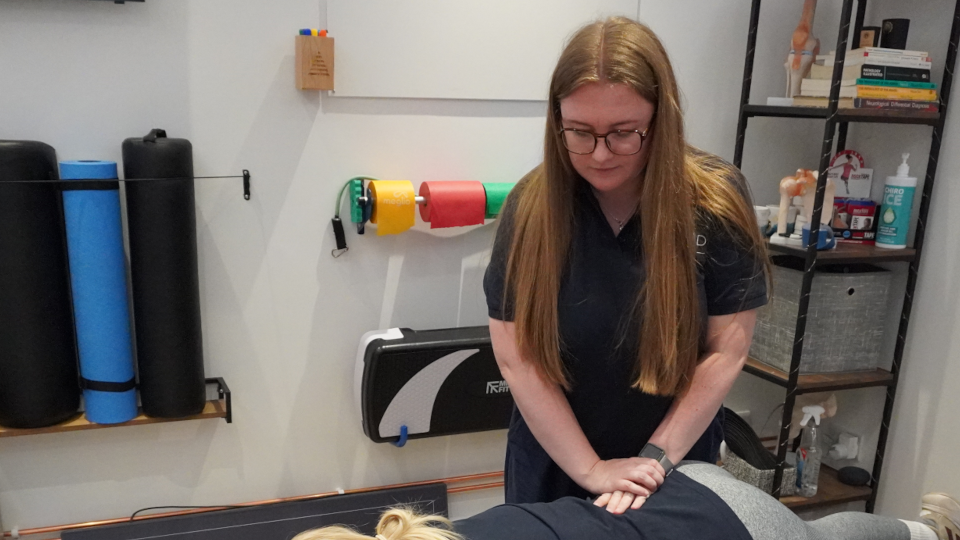
Chiropractor Yasmin going to work on a low back.
When a nerve is irritated, part of the problem is often how the joints and muscles of the lower back and pelvis are moving. Gentle, specific adjustments and hands-on techniques can help restore more comfortable movement, take some of the load off the sensitive area, and reduce the guarding and stiffness that build up when you've been in pain and moving carefully.
We're deliberately measured with sciatica. An irritated nerve doesn't like being provoked, so the aim is to calm things down and improve movement without repeatedly flaring symptoms. Having two chiropractors also means we can offer continuity — if you prefer to see the same person each time, or you'd like a second pair of eyes on a stubborn case, that's easy to arrange.
Acupuncture & Dry Needling For Nerve Pain
Alongside chiropractic care, we also offer acupuncture and dry needling (with Mike, Yasmin or Hannah) and it can be a useful addition for sciatica, particularly when pain and muscle tension are driving each other in a vicious cycle.
These therapies use fine needles to target tight, irritable points within a muscle or fascia; the sort that can refer pain down the leg and mimic or feed into sciatica. For the right patient, it can help settle stubborn muscle tension that's proving hard to shift with hands-on work alone.
Like all other manual interventions, ultimately needling therapies aim to restore proper movement to help speed the healing process.
Sports Therapy and Rehabilitation
This is where Hannah and Abi come in. Both are sports therapists, and rehab is at the heart of getting sciatica to stay away rather than just quieten down for a fortnight.
Hands-on care can calm a nerve down, but the thing that builds lasting resilience is movement and strength. Hannah and Abi work with patients on graded, progressive rehab — starting with gentle movements and positions of relief, then gradually building the strength and control in the back, hips and glutes that take pressure off the whole system.
The key word is graded. We're not interested in boom-and-bust, where you feel good for a day, overdo it, and pay for it all week. The plan is built around where you are now and nudged forward at a pace your symptoms can handle.
Massage and Soft-Tissue Work
Our Sports Therapists also offer massage and soft-tissue therapy, which has a real role in sciatica recovery.
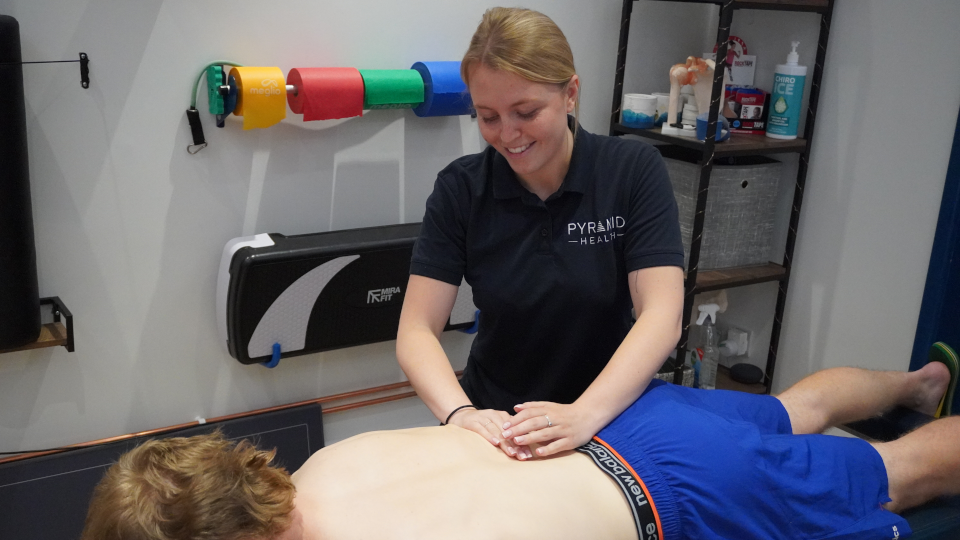
Massage can be effective in calming sensitive tissues
When you've been protecting a sore leg or back for a while, the surrounding muscles — especially in the buttock and the back of the leg — can get tight, tired and protective. That tension can add to the irritation and make everything feel worse. Soft-tissue work helps release that guarding, improves comfort, and often makes the active rehab feel much more manageable. For the masquerader cases we mentioned — where tight deep buttock muscles are the real culprit — this kind of work can be a big part of the answer.
Nutrition: Support For A Sensitive System
We're not going to tell you a supplement cures sciatica, because it doesn't. But when a nerve is irritated and the body is trying to recover, nutritional foundations matter. Several nutrients play a direct role in how nerves and muscles work and how well you sleep and repair — the B vitamins (B12 in particular), magnesium with vitamin B6, and vitamin D. If someone's foundations are poor, an already irritable system can be that much harder to settle.
Chronic Inflammation: A Driver of Persistent Cases
Where nutrition becomes really interesting is in the stubborn, long-running cases — the sciatica that grumbles on for months and never quite settles, even when the hands-on work and rehab are spot on. In some of these people, part of what's keeping the nerve sensitive is low-grade systemic inflammation: a slow, background level of inflammation across the body that isn't caused by the back at all, but that leaves sensitive tissues quicker to fire and slower to calm.
Plenty of everyday things feed that background inflammation — a diet heavy in ultra-processed food and sugar, being low in the anti-inflammatory omega-3 fats found in oily fish, carrying extra weight around the middle, poor sleep, chronic stress, and gut and food-sensitivity issues. None of these cause sciatica on their own. But in a persistent case they can be the reason the fire keeps smouldering, and addressing them can be what finally tips the balance towards recovery.
So for the right patient — usually the long-standing, "why won't this settle?" cases — we go a bit deeper. That might mean:
Looking properly at diet, dialling down the ultra-processed food and sugar and building in more of the whole foods, oily fish and vegetables that help settle inflammation rather than stoke it.
Checking foundations objectively. We offer blood testing at the clinic, so rather than guessing we can actually look at things like vitamin D and B12 and markers of inflammation, and target what we find.
Sorting the basics that quietly drive inflammation — sleep, stress and gut health — because they matter more than most people expect.
It's worth being clear-eyed about this: nutrition here is support for a sensitive, inflamed system, not a standalone cure, and it tends to be a slow burn rather than a quick fix. But for someone who's been stuck for months, it can be the missing piece that nothing else has addressed.
When Conservative Care Isn’t Enough
We'll always be straight with you about this. Most sciatica settles with the kind of conservative care above, and that's genuinely where we'd start for the vast majority of people. But a minority of cases — usually severe ones, with significant nerve compression, real weakness, or symptoms that drag on for a very long time despite doing the right things — need more than hands-on treatment and rehab.
For those people, a scan can earn its place, and occasionally surgery is the best answer rather than the last resort. If your case looks like one of those, we won't keep you on the treatment table hoping it comes good — we'll say so, and help you get in front of the right GP or specialist. Knowing when not to keep treating is part of doing this properly, and it's what collaborative care is for.
Putting It All Together
The point of having all of this under one roof isn't to sell you the whole menu. It's the opposite. It means we can pick the two or three things that will genuinely help you, in the right order, and adjust as you improve.
A typical plan might start with hands-on care and soft-tissue work to calm things down, move into graded rehab to build resilience, and bring in acupuncture, gait analysis or nutrition where they'll add something. Someone else's plan might look quite different. That's the whole idea.
If you're in Exmouth or East Devon and you're tired of guessing whether it's sciatica — or tired of a plan that isn't working — come and get properly assessed. We'll tell you what's actually going on and build a plan around you.