
Condition of the Month: Sciatica
If you've ever had a pain that starts in your back or buttock and travels down the back of your leg, you've probably wondered if it's sciatica. It's one of the most common things we hear about in clinic, and it's also one of the most misunderstood. The good news is that most people with sciatica get better, and understanding what's actually going on is a big part of that.
This post is the plain-English guide we wish every patient had before they started worrying. We'll cover what sciatica actually is, the things that pretend to be sciatica but aren't, when a symptom genuinely needs urgent attention, and the questions we get asked most often.
What is Sciatica?
Sciatica isn't really a diagnosis on its own. It's a description of a symptom: pain that follows the path of the sciatic nerve.
The sciatic nerve is the largest nerve in your body. It's about as thick as your thumb where it starts, and it runs from your lower back, through your buttock, and down the back of each leg. When that nerve gets irritated or compressed somewhere along its path, you can feel it anywhere along the line — often in the buttock, the back of the thigh, the calf, and sometimes right down into the foot.
That's why sciatica can feel so different from person to person. Some people describe a deep ache. Others get a sharp, electric, shooting pain. Pins and needles, numbness, or a feeling of weakness in the leg are all common too.
Here's the single most important thing to hold onto: nerves can be sensitive without being permanently damaged. An irritated nerve is a bit like a car alarm that's become too easy to set off. The alarm going off doesn't mean the car is being stolen — it means the system has become oversensitive. Our job is to calm that sensitivity down, restore comfortable movement, and rebuild your confidence, without repeatedly flaring things up.
What causes the nerve to become irritated?
There are a few common reasons the sciatic nerve gets grumpy. The most talked-about is a disc in the lower back pressing on or irritating a nerve root. Discs sit between the bones of your spine and act as cushions. Sometimes the outer part bulges and irritates a nearby nerve.
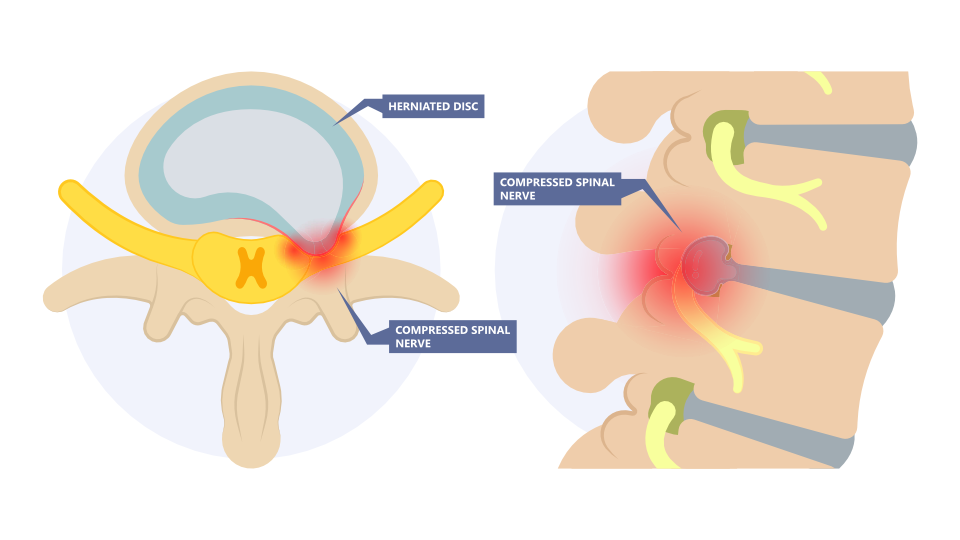
A disc herniation is one potential cause of low back and leg pain.
Now, a quick word about discs, because the language around them causes a lot of unnecessary fear. You may hear phrases like "slipped disc" or "my disc has gone." Discs don't actually slip, and a disc problem is not a life sentence. Disc irritation is common, discs can heal just like every other tissue, but it can be very disabling. It's also worth nothing that disc degenration is often found on scans of people with no pain at all, and it frequently settles with the right plan. We see this in clinic all the time.
Other common contributors include tightness and irritation in the muscles of the buttock, changes in how you've been loading your back (a sudden increase in activity, a lot of sitting, or a heavy lifting spell), and general deconditioning after a quiet or stressful period. Often it's a combination rather than one single villain.
The Masqueraders: What Else Can Cause “Sciatic” Pain?
Not every pain down the leg is true sciatica, and getting the right diagnosis is key to an accurate prognosis and treatment plan. Here are the usual suspects we assess for.
The deep buttock muscles (often called piriformis-type pain). The sciatic nerve passes very close to a group of muscles deep in your buttock. When those muscles are tight or irritated, they can create a very sciatica-like ache and refer pain down the leg. It can feel almost identical, but it responds to quite different treatment.
The hip joint. Hip problems love to disguise themselves. Wear-and-tear or irritation in the hip can send pain into the groin, the buttock, and down the thigh. We've seen plenty of "stubborn sciatica" that turned out to be a hip that needed attention.
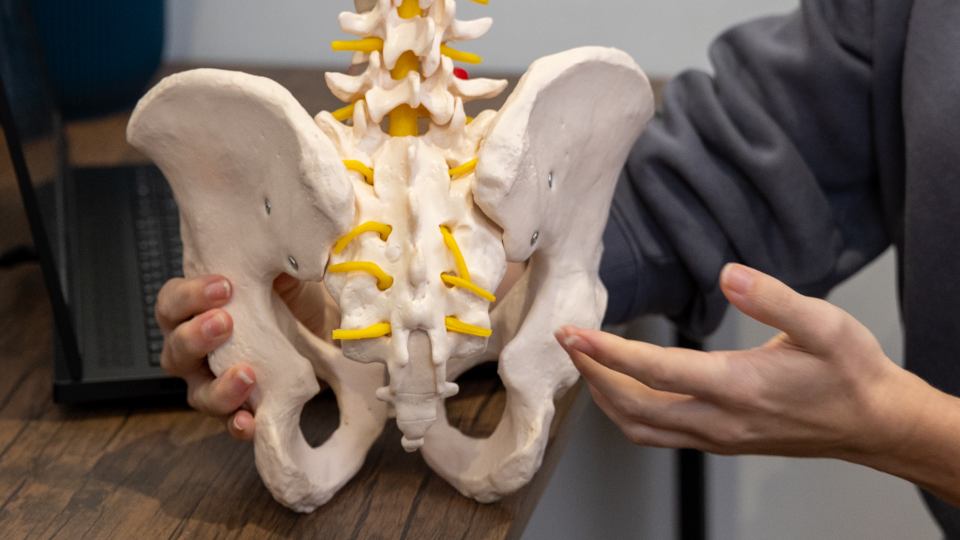
The pelvic girdle is very complicated and the path of pain is often not straightforward.
The sacroiliac joint (SIJ). These are the two joints where your pelvis meets the base of your spine. When one gets irritated, it can produce pain across the buttock and into the upper thigh that mimics nerve pain.
Referred pain from the lower back itself. Sometimes the back structures refer a dull, spread-out ache into the buttock and thigh without truly involving the nerve. It can feel like sciatica but behaves differently and usually doesn't travel as far down the leg.
Why does this matter? Because the treatment that calms a genuinely irritated nerve is not the same as the treatment for a cranky hip or a tight buttock muscle. A proper hands-on assessment is how we tell them apart — and it's the reason we don't just hand out a generic "sciatica programme" to everyone who walks in with leg pain.
“Red Flags”: When Leg or Back Pain Needs Urgent Attention
Almost all sciatica is not dangerous and improves with time and the right care. But there are a small number of symptoms that need prompt medical attention rather than a "let's wait and see" approach. We want you to know these — not to frighten you, but so you can act quickly in the rare case they appear.
Seek urgent medical advice (your GP, NHS 111, or A&E depending on severity) if you develop:
Numbness or altered sensation around the saddle area — the parts of your body that would touch a saddle (inner thighs, genitals, buttocks, back passage).
Loss of control of your bladder or bowels, or a new inability to feel when you need to go.
Progressive weakness in the leg that is clearly getting worse, especially in both legs.
Severe, rapidly worsening symptoms, particularly alongside feeling generally unwell, a fever, or unexplained weight loss.
These are uncommon, but they're worth memorising. If in doubt, get checked — it's always the right call.
Frequently asked questions
Should I rest or keep moving?
Gentle movement almost always beats bed rest. Lying still for days tends to make an irritated nerve more sensitive, not less. That doesn't mean pushing through agony — it means staying as active as your symptoms sensibly allow, finding positions that ease things off, and gradually building back up. We'll help you find that line.
Do I need a scan?
Usually not, at least not straight away. Scans often show disc changes in people with no pain whatsoever, so a scan can sometimes cause more worry than it solves. For most people, a good clinical assessment tells us what we need to know. If your symptoms don't follow the expected pattern, or if there are red flags, that's when imaging earns its place. It's all about using the right tool at the right time.
How long does sciatica take to settle?
Honestly, it varies. Many people notice meaningful improvement within a few weeks, while more stubborn cases can take a couple of months to properly resolve. Recovery also isn't always a straight line — a flare-up on a bad day doesn't mean you're back to square one. The aim is a steady overall trend in the right direction.
While most sciatica settles, a minority of people — usually those with severe nerve compression — do suffer for months or even years, and it can be very debilitating. If that's the situation, conservative care still has plenty to offer, but it isn't always the whole answer. Sometimes a scan and a specialist opinion are exactly what's needed, and occasionally surgery is the right call rather than something to keep avoiding.
Will I need surgery?
Most people won't — the large majority of sciatica improves without it. But for a smaller group, particularly those with significant, persistent nerve compression, weakness, or pain that won't settle despite doing all the right things, surgery can be the best option and can make a real difference. The honest answer is that it depends on your specific case. Our job is to help most people avoid it, and to recognise the minority who'd genuinely benefit and get them in front of the right specialist rather than keep treating in hope.
Will it come back?
It can, but you're not powerless. A lot of what we do is aimed at resilience — restoring movement, building strength gradually, and giving you the confidence to trust your back again. People who stay active and keep up a few simple habits tend to have fewer repeat episodes.
Is it doing permanent damage?
For the vast majority of people, no. Pain can make your back and leg feel fragile, but hurting is not the same as harming. An oversensitive nerve is a signalling problem, not a sign that something is breaking.

Our friendly team can help you understand your problem and the path ahead.
Where We Come In
If you're dealing with pain down the leg here in Exmouth or the wider East Devon area, the most useful first step is a proper assessment — the kind that works out whether this is true sciatica or one of its masqueraders, and builds a plan around your specific situation.
That's exactly what we do at Pyramid Health. In our next post we'll walk through how our team actually treats sciatica, from hands-on care to rehab and everything in between.
For now, if this sounds like you, we're happy to help. Call us on 01395 911493 or book online and we'll take it from there.