
What Dislocating My Shoulder Taught Me About Recovery
Mike Richards shares his Shoulder Dislocation story (so far) and tells you what you can do if your shoulder pain won’t settle.
Thirty seconds. That's how long I lasted on the rugby pitch before it all went wrong.
I'd been on for barely half a minute when I got the ball, got tackled, and went down, and as I landed someone came down on the back of my shoulder with a very big crunch. I knew straight away that something wasn't right, I just had no idea what yet, and I had to come off, which, if I'm honest with you, was a fairly humbling way to spend a Saturday afternoon.
I'm writing this as a recovery diary because over the past few weeks I've learned a great deal about dislocated shoulders, and even more about how we actually treat them. A fair bit of it I already taught patients day in, day out. Living through it myself, it turns out, has been a completely different thing.
The Diagnosis
My first thought was a torn rotator cuff, because I simply couldn't lift the arm at all. Then the pitch-side first aider said the thing that made my stomach drop: something bony didn't feel right in there, and I needed to get to hospital. By then my hand had started to go numb too. My dad drove me in, and because I couldn't get remotely comfortable in the car I started having a feel around the joint myself. That's when I worked it out. There was just nothing sitting in the socket where it should have been, so I'd clearly dislocated it, although even with everything I know it didn't feel the way I'd always imagined a dislocation would.
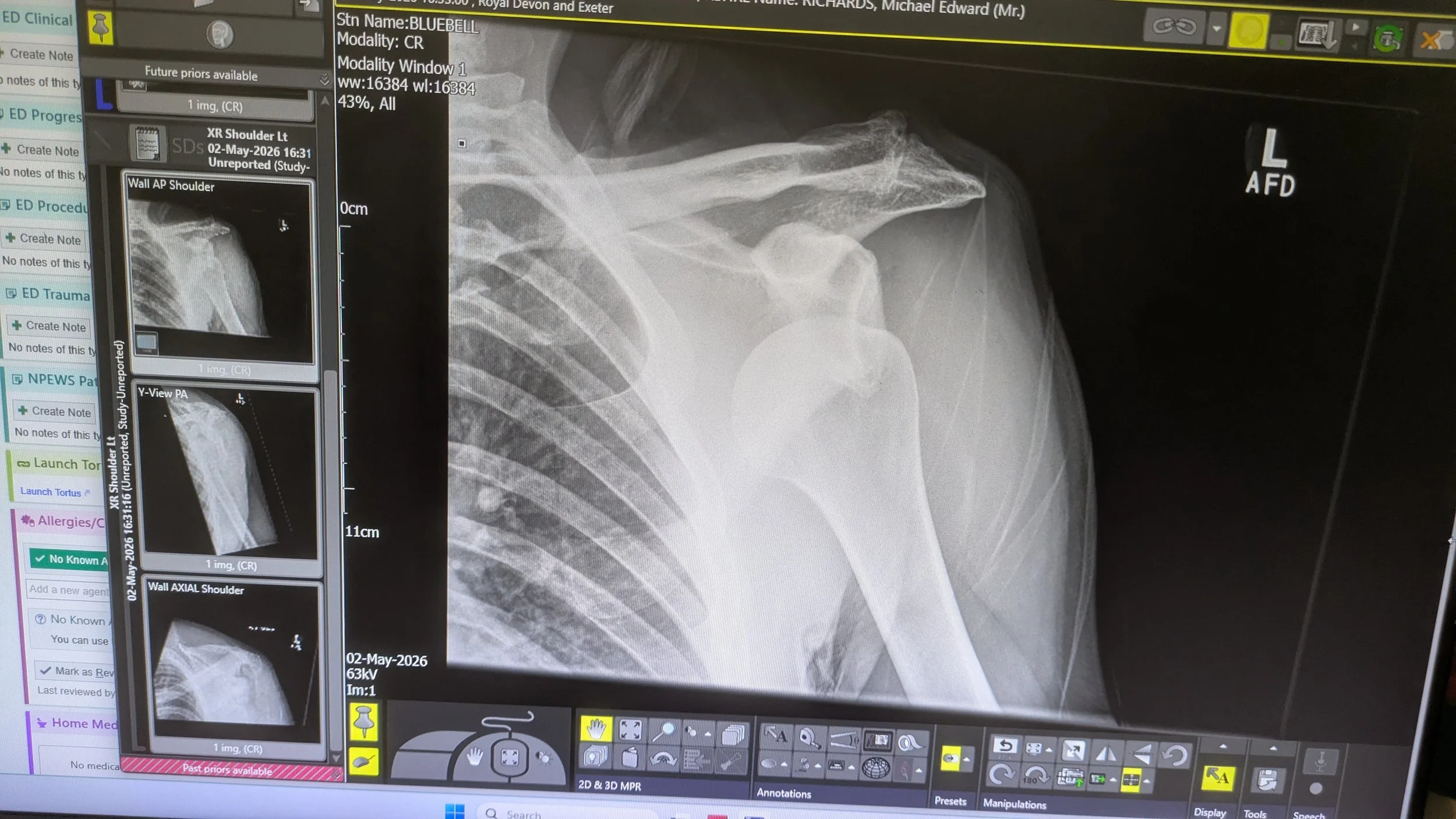
The eagle eyed among you will spot that the ball is not quite in the socket!
I'll give the hospital their due, because the whole thing went better than I had any right to expect. I walked straight in, still in my muddy kit, had an x-ray within 15 minutes, and the moment they laid me down the pain dropped from a seven or eight out of ten to something more like a three. A very skilled and reassuring consultant popped the shoulder back into joint, and that was the exact moment I realised quite how sore it really was. They strapped me into a sling, warned me at some length that it was going to hurt, and sent me on my way. Eight days on, though, I'll be straight with you: the pain has been very manageable, and I've been genuinely lucky, for reasons I'll come to.
Movement As Medicine
Here's something that surprised even me, and it set the tone for everything that followed. Before I'd even realised the shoulder was out, I'd picked up my kit bag and carried it from the car with that same arm, simply because my other hand was full. So I never really stopped using the shoulder, and I'm now convinced that helped enormously (don’t pick up heavy things with dislocated shoulder though). Through those first awkward days I kept doing small, ordinary things with the affected arm — the washing up, a bit of gentle reaching, nothing heroic and certainly no lifting the children over my head — and I noticed the same pattern again and again.
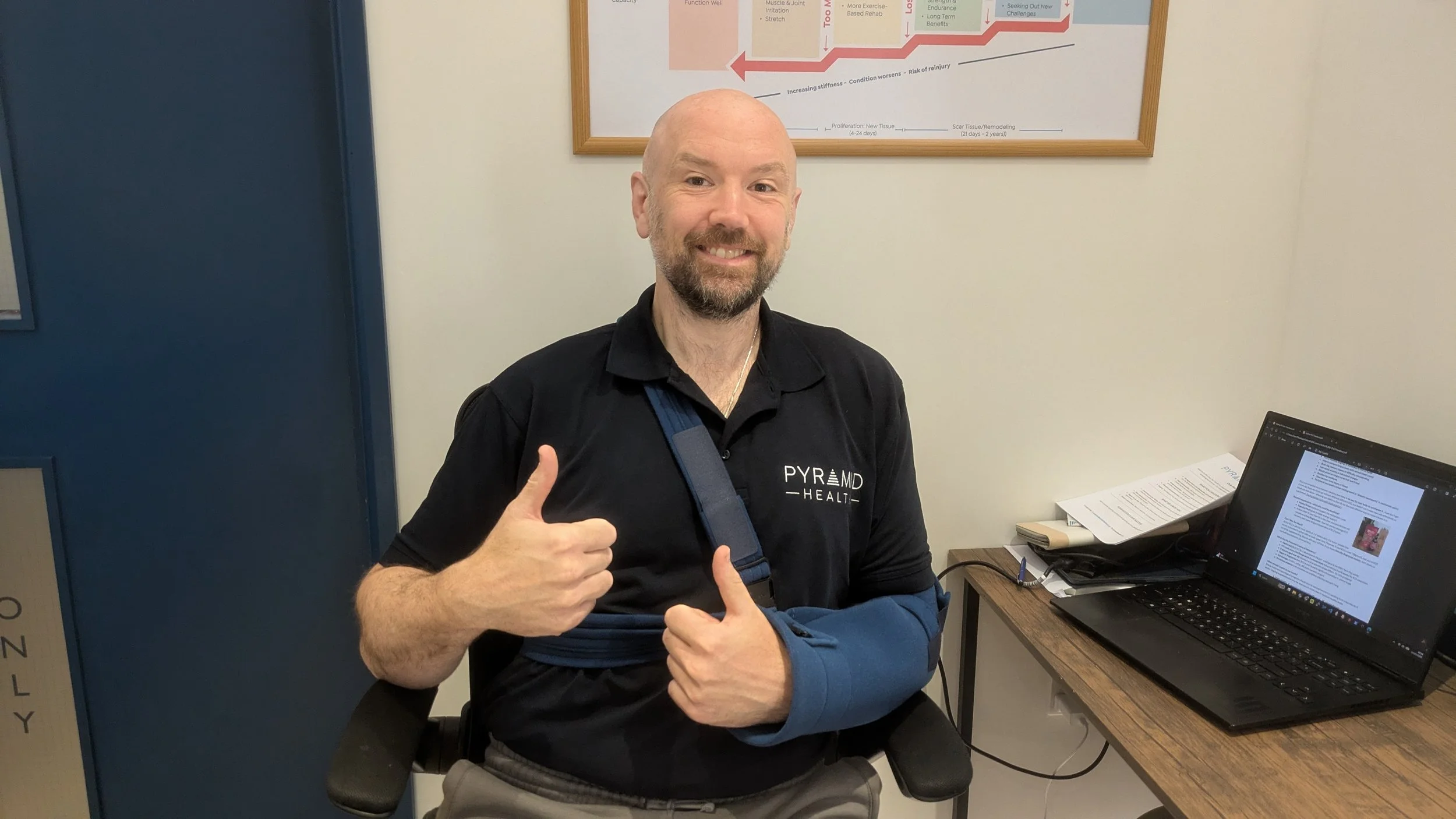
Back at work because I don’t need two hands to type
First thing in the morning the shoulder would be stiff and unhappy, I'd wake at half five not enjoying life one bit, and then I'd get up, get moving, and within a short walk it felt like a different shoulder altogether. This is exactly what we tell patients in clinic, and there was something quietly reassuring about feeling it prove true on my own body. Joints don't want to be wrapped in cotton wool. They want sensible, graded movement, and they'll usually thank you for it.
The fracture clinic threw up an unexpected silver lining, too. It turns out there's a good age to dislocate your shoulder, and I'm roughly it. Younger people tend to tear the labrum, which is the rim of cartilage that deepens the socket, while older people more often tear part of the rotator cuff, the group of muscles that hold the joint steady. At my age the surgeon reckoned I'd most likely just stretched or torn the capsule, the sleeve of tissue wrapped around the joint, and that tends to settle reasonably quickly. The one thing to keep half an eye on was a frozen shoulder, though the odds of that were thankfully low.
The slowest part of the whole business has been the nerves: I've had weakness and numbness running through my hand along the ulnar nerve, the one that supplies the little-finger side, and while it's steadily improving, that sort of thing can take anywhere from two to twelve weeks to come good. Patience, as my family will happily tell you, has never been my strong suit.
Where I got it wrong
Around day ten it caught up with me. I had two of the worst nights' sleep of the entire ordeal, and I finally gave in and took some of the codeine the hospital had sent me home with, purely to knock myself out for a few hours. Looking back, I'd been overdoing it. I'd leaned far too hard into the idea that if a bit of movement is good then loads must be better, and the shoulder was now telling me, in no uncertain terms, to ease off. That same day I saw Hannah, our sports therapist, who as luck would have it has a lot of close personal experience with shoulder dislocations through her own family.
She watched me move, told me I was actually doing well for the timeline, and then handed me a set of exercises that were, I'll be honest, a good deal gentler than my ego wanted them to be. I was a little disappointed. But she was right and I was wrong, because they were precisely what the shoulder needed at that stage, and my job was simply to slow down and accept that this would be a slow process whether I liked it or not. There's a real lesson buried in there about being a good patient, even when you're convinced you know better than the person treating you.
Here’s the exercises that brought me back down to Earth.
Two weeks after a dislocated shoulder: turning the corner
By around day thirteen it genuinely felt as though something had shifted for the better. The pain was well down, the evenings were comfortable in a way they hadn't been, and movements that had been completely off the table, like opening the arm out into external rotation, were quietly coming back. So I made the call to return to work two weeks and two days after the injury. I won't pretend I wasn't nervous about how the shoulder would cope with a full clinic day, but with a few small tweaks to how I positioned and used it, the days have been more or less pain-free. Around the same time I got back to refereeing touch rugby, ran about for the best part of forty-five minutes, and even threw a ball around carefully with my left arm. A bit achy afterwards, sure, but the good kind of achy.
Underneath all of it I leaned hard on the things we know can help recovery. I stayed on top of my supplements and made a point of getting enough protein, because repairing tissue needs the right raw materials to work with. I used Chiro Ice, a muscle stimulation machine and a fair bit of self-massage to keep everything loose and moving between appointments. And I had hands-on treatment from the team, with Callum and Yasmin freeing off my neck and upper back and doing soft tissue work around the shoulder itself in addition to Hannah’s work. The way I picture it, each session takes a little more grit out of the bearings, so the whole recovery runs that bit smoother.
The Thing I Keep Coming Back To
There's one reflection from all this that I genuinely can't shake, and it's the part I most want patients to hear. There were a handful of moments — a couple of big, alarming clicks with real pain behind them — where I had to stop and think hard about what that pain was actually telling me. Because I've had the training, I could recognise it for what it was: tissue being loaded and resettling, not something tearing or going badly wrong. But if I hadn't had that knowledge, I'm in no doubt it would have frightened the life out of me. And that fear is the thing that quietly wrecks recoveries.
It makes you guard the arm, hold it still, and instinctively avoid the very rehab that gets you better, all of which sets you further back. So when I say that understanding your pain matters, I mean it changed my entire recovery. Pain is information far more often than it's a warning to stop, and used as a guide rather than a wall to hide behind, it's what got me back to work two weeks after a first-time dislocation. Having people around you who can calmly tell you what's normal and what isn't is worth more than almost anything else when you're hurt and a little bit scared. Although…
Recovery Isn't A Straight Line
At about four and a half weeks I was feeling really good, possibly a little too pleased with myself, and then my mum's dog decided to make a break for it. I went haring off after him, took a steep bank rather faster than was wise, and threw my left hand out to stop myself falling, at which point there was a nasty little snick that I won't pretend didn't hurt. It set me back. But only by about a week, and as I sit here writing this I'm pretty much back to where I'd got to before the great dog chase. That, really, is recovery in a nutshell. It almost never runs in a clean straight line, and a setback is not the same thing as going back to square one. My range of movement is virtually 100%, I'm into the strength-building phase now, and the whole focus from here is on building the joint up properly so this doesn't happen again. So that's the story so far: a monster of a recovery, one genuinely humbling Saturday, and a renewed respect for the advice we hand out every single day.
If You're Carrying An Injury That Won't Settle
You really don't need to have dislocated anything dramatic on a rugby pitch to benefit from getting it looked at. Whether it's a shoulder, a back that keeps flaring up, or a niggle you've been quietly ignoring for months, the same principles hold true every time. Keep moving sensibly, learn what your pain is genuinely telling you, and get the right rehab from people who know what they're doing.
Or if you’re not sure what to do with it - book into our FREE Shoulder Screening Event on Saturday July 11th. Click below to reserve your spot now, and we’ll give you the best advice on how to finally put that problem to bed.
