
What Is… Plantar Fasciitis?
If you’ve ever had foot pain, you’ve probably had someone tell you that you have Plantar Fasciitis. Most of our patients can’t pronounce it though, let alone understand it! So we thought we’d put together a layman’s guide to the most common type of foot pain going.
Why The Mouthful?
First, we probably need to define some terms and decode the medical jargon.
Plantar just means “the bottom of the foot”.
Fascia is a medical word for connective tissue. Subtly different types of fascia are actually found in every tissue of the body, but that’s not a conversation we need to have right now. For our purposes, Plantar Fascia then refers to the soft tissue on the plantar (or bottom) aspect of the foot.
-itis means inflammation. Sinusitis = inflammation of your sinuses. Colitis = inflammation of your gut. Plantar Fascia-itis = inflammation of the soft tissue on the bottom of your foot.
Congratulations. Now you can speak medicalese! So let’s get into the what and why:
Classic Plantar Fasciitis Symptoms
Plantar Fasciitis patients usually come to us with some variant of this story: they swing your legs out of bed, put their foot on the floor, and the first few steps feel like they're walking on broken glass. After a minute or two it eases off and they get on with your day. Then they sit down for a coffee, stand up again, and there it is.
That pattern is the signature of plantar fasciitis, and it's one of the most searched foot problems on the internet for good reason. We see it constantly in clinic: in runners, in people who stand all day, in new dog owners, and in plenty of people who can't think of anything they did differently. The good news is that the vast majority of cases settle with the right plan. The catch is that "the right plan" depends on what's actually going on under your heel, and why cookie-cutter advice can lead to opposing outcomes in patients with identical symptoms.
In this article, we'll cover what the plantar fascia actually does, why it gets sore, the things that get mistaken for plantar fasciitis, the rare symptoms that need a doctor, and the questions we get asked most.
Then, in Parts 2 & 3, we’ll talk about what we do about it.
What Is The Plantar Fascia?
The plantar fascia is a thick, tough band of connective tissue running along the sole of your foot, from the underside of your heel bone to the base of your toes. It isn't one single strap. It's made of many layers of fibres, a bit like a rope, and it has one main job: to stop the front of your foot drifting too far away from the back.
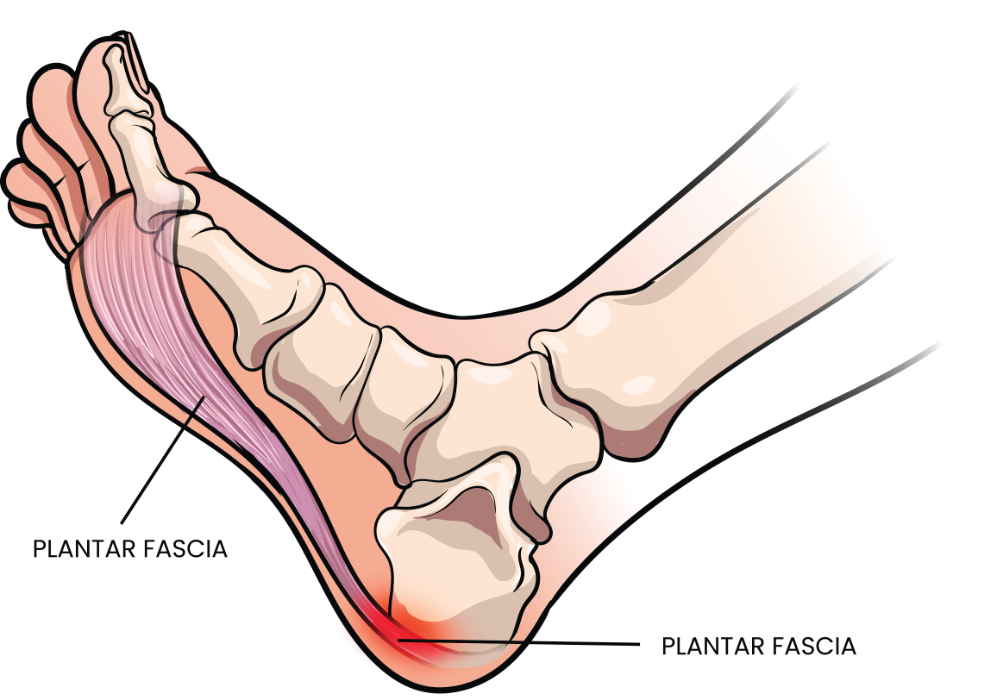
Think of your foot arch as a bow, and the plantar fascia as the bowstring tying the two ends together. Every time you stand, the arch tries to flatten and the string takes the strain. When you push off your toes, something clever happens. Bending your big toe upwards winds the fascia tighter, shortens the foot and stiffens the whole arch into a solid lever. That's what lets your calf muscles push you forward efficiently. Engineers call it the windlass mechanism; you can call it free energy.
The point is that the plantar fascia is loaded on every step you take, and it's loaded hardest right where it attaches to the heel. That attachment point is where plantar fasciitis lives.
So What Goes Grong?
Here's the single most important thing to understand: plantar fasciitis is a load problem, not a damage problem. The tissue has been asked to do more work than it currently has the capacity for, and it's complaining.
The name is a bit misleading, too. The "-itis" ending means inflammation, and in the first few weeks of a new heel pain there probably is some. But the cases we see most often have been going on for months, and by then the picture has changed. The tissue at the heel attachment becomes thickened, or in some people frayed and thin, and it's stuck in a slow, grumbling repair that never quite finishes. That's why long-running heel pain behaves so much like a tendon problem, and why it responds to the same kind of treatment tendons do.
Just like tendons, the plantar fascia is a hard-wearing tissue that can take a lot of abuse because it doesn’t overly concern itself with blood vessels and other (relatively) structurally weak ingredients. What that does mean, however, is that once it’s injured, that lack of blood supply can make healing a slow process.
Some clinicians now prefer the term plantar fasciopathy for exactly this reason, and not just because they like to be technically correct. It matters because a tissue that's failing to repair needs a different approach from one that's simply inflamed. Rest and anti-inflammatories can take the edge off, but they rarely fix it.
Why It Happens
Almost every case comes down to the same thing we see in running injuries: the load on the tissue has gone up faster than the tissue's ability to cope. We sometimes call it the rule of "too": too much, too soon, after too little for too long. Our bodies don't like holidays or surprises.
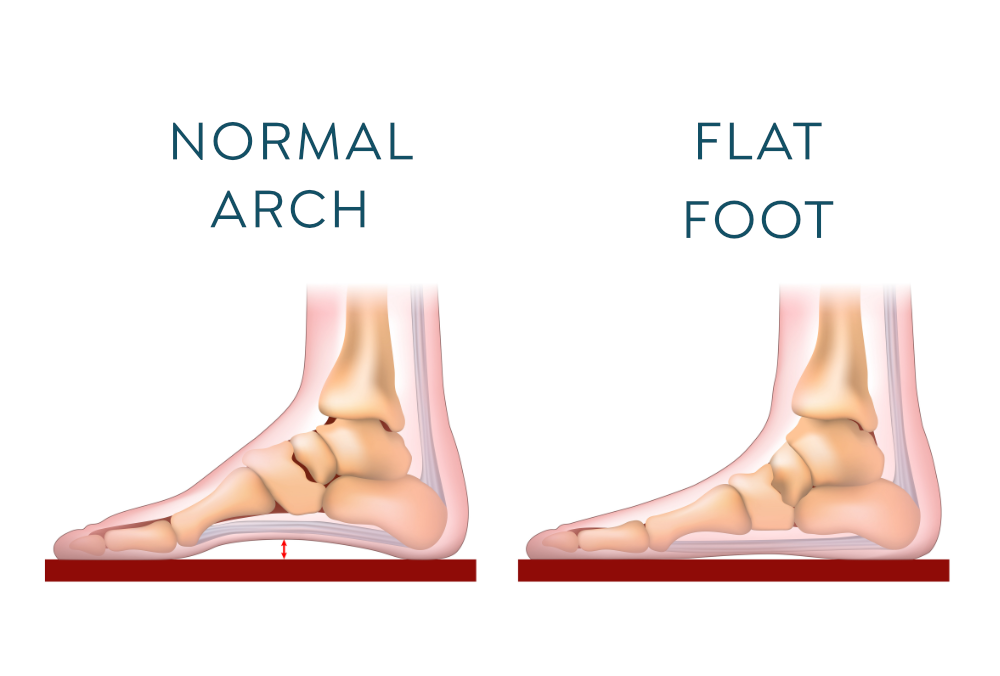
“Flat foot” is a normal position, but feet that are unable to create an arch consistently may predispose to Plantar Fasciitis.
The stories are remarkably consistent. Someone who's been fairly sedentary gets a puppy and is suddenly walking two hours a day. A new couch-to-5k programme. A job change that means eight hours on a concrete floor. Coming back to exercise after an operation or a quiet winter. A holiday spent walking miles in flip-flops. None of these are wrong things to do. The problem is the speed of the change.
Some things make a foot more likely to tip over the edge:
Tight calves and a stiff ankle. This is the one most consistently linked to plantar fasciitis in the research. If your ankle can't bend forward enough when you walk, your foot borrows the missing movement by rolling inwards (pronating) more than it should, and that stretches the fascia on every step.
Carrying more weight. Simple physics: more load per step. It's not a judgement, just part of the maths.
Footwear and surfaces. Worn-out trainers, unsupportive shoes, or simply a change in the style of footwear all add up. Running shoes generally need replacing every 250 miles or so, which is sooner than most people think.
How your foot moves. Feet that roll in heavily and struggle to re-stiffen for push-off tend to overload the fascia. Rigid, high-arched feet tend to bruise the heel instead. This is one of the things our Footscan pressure plate gives us unrivalled insight useful for, and we'll come back to it in Part 2.
Usually it's a combination of two or three of these rather than one single villain.
The Masqueraders: What Else Could It Be?
This is the part most articles skip, and it's the part that saves people months of frustration. A podiatrist we trained with likes to say there are forty-odd different heel pains that all get called plantar fasciitis. Most of them need a different plan. These are the ones we check for most often.
Fat pad thinning or swelling. Under your heel bone sits a natural shock-absorbing cushion, one to two centimetres thick. With age, hard floors or a lot of impact, that pad can thin out. The pain is a deep, bruise-like ache right in the centre of the heel, worse on hard surfaces and when barefoot, and it doesn't usually have the classic "first steps then eases" pattern. It's often mixed in with true plantar fasciitis, which is one reason some people don't improve. This can be very difficult to pick up without an ultrasound scan, which we can arrange if you’d like.
Heel bursitis, or "policeman's heel". A small fluid-filled sac under the heel gets irritated. It tends to hurt more constantly rather than easing as you warm up, and when we press around the heel, the tender spot is in a slightly different place.
Tibialis posterior tendon problems. This is the most common misdiagnosis we see. The tibialis posterior is the muscle that holds your arch up. When its tendon is struggling, the arch starts to drop and the plantar fascia gets overloaded as a knock-on effect. The clue is pain or swelling on the inside of the ankle, just behind the ankle bone and running down towards the arch. Treat the fascia alone and it keeps coming back.
Achilles and the back of the heel. Plenty of people say "plantar fasciitis" and then point to the back of their heel. That's Achilles territory, and the treatment is different.
Muscle strains in the foot and calf. Several small muscles attach at almost exactly the same spot as the fascia. A strain in one of them can feel identical to the touch.
Nerve irritation. A small nerve runs under the heel and can get pinched. Burning, tingling, pain that's there at rest or at night, or pain that spreads across the sole all point away from a simple fascia problem.
The heel spur. We'll give this its own paragraph because it causes so much needless worry. If you've had an X-ray, you may have been told you have a heel spur and assumed that's what's stabbing you. It almost certainly isn't. Heel spurs show up on X-rays of plenty of people with no pain at all, and the spur usually sits in the muscle attachments next to the fascia rather than in the fascia itself. There's no consistent link between having a spur and having heel pain. The spur is mostly a bystander, not the cause, and usually you don't need it removed.
Why does all this matter? Because the treatment that helps an overloaded fascia is not the same as the treatment for a bruised heel pad, a struggling arch tendon or an irritated nerve. A proper assessment is how we tell them apart, and it's why we don't hand out one generic "plantar fasciitis programme" to everyone who walks in with a sore heel.
Red Flags: When Heel Pain Needs A Doctor
Almost all heel pain is not dangerous and improves with time and the right care. But there are a small number of situations where you should see your GP (or NHS 111, or A&E if it's severe) rather than wait and see. We want you to know these, not to frighten you, but so you can act quickly in the rare case they apply.
A sudden snap or tear in the sole or heel, especially with bruising, or a heel you suddenly can't put weight on. This could be a rupture of the fascia or a stress fracture of the heel bone.
Heel pain alongside other inflammatory signs: stiffness in several joints lasting more than half an hour in the morning, pain in both heels at once, psoriasis, inflammatory bowel disease, or a recent bout of eye inflammation. Some inflammatory arthritis conditions pick on the heel attachments first, and that needs a different route.
Numbness, weakness or pain that travels from your back or down your leg into the foot. That points to a nerve, not the fascia.
A hot, red, swollen heel, or feeling generally unwell with a fever. Infection is rare, but it's urgent.
Heel pain in a child aged roughly 8 to 14. This is usually a growth-plate irritation called Sever's disease, which is managed quite differently from adult heel pain.
If in doubt, get checked.
Frequently asked questions
Should I rest it completely? No, contrary to a lot of advice. Complete rest tends to leave the tissue weaker and just as sensitive when you start again. The aim is to calm things down while keeping the foot working within what it can tolerate, then build that tolerance back up. There's a sweet spot between "push through it" and "stop everything", and finding it is half the battle.
Do I need an X-ray or scan? Rarely, at least not to start with. An X-ray mostly tells you whether you have a heel spur, and we've covered why that doesn't change much. An ultrasound scan can be useful in stubborn cases to see how thick or frayed the fascia is, but for most people a good clinical assessment tells us what we need to know.
How long does plantar fasciitis take to get better? Honestly, it varies, and it's usually slower than people hope. Recent cases can settle in a few weeks with the right changes. Anything that's been going on for more than a couple of months needs at least six weeks of consistent work before the tissue properly starts to remodel, and a heel that's been sore for a year can take several months. Progress isn't a straight line either. A bad morning after a long day on your feet doesn't mean you're back to square one.
Are insoles the answer? Sometimes, for some people, and usually as a temporary tool rather than a life sentence. The problem with most shop-bought insoles is that they push up under exactly the spot that hurts. A well-designed custom insole works differently, changing how your foot loads so the fascia gets a break while you build strength. Think of it as a tailored piece of ground for your foot to roll across, not a splint.
Will it come back? It can, but you're not powerless. Most recurrences come from the same "too much too soon" pattern that started it. People who keep their calves flexible, build a bit of foot and calf strength, replace worn shoes and increase activity gradually tend to have far fewer repeat episodes.
Is it doing permanent damage? For the vast majority of people, no. A sore heel feels fragile, but hurting is not the same as harming. The tissue is overloaded and sensitive, not breaking. Once the load and the capacity are back in balance, it settles.
What To Do About It?
Ah, that would be a question for Part 2.