
How We Treat Plantar Fasciitis
In our last post we explained what plantar fasciitis actually is: a tough band under your foot that's been asked to do more than it can currently cope with, and has got stuck in a cycle of slow, grumbling repair. If you haven't read it, you can check it out here. One of the key takeaways? There's no single "plantar fasciitis treatment" that's right for everyone.
Two people can walk in with the same first-steps-in-the-morning heel pain and need quite different plans. One has stiff ankles and a foot that rolls in heavily. Another has an inflamed or thinning heel pad and a job on a concrete floor. A third has a struggling arch tendon doing a convincing impression of fasciitis. So before we treat anything, we assess. Once we know what we're dealing with, we can match the plan to the person.
Here's how that looks in practice for the ordinary, non-stubborn case. (The really persistent ones get their own Part 3.)
Our Plantar Fasciitis Assessment
We take a history first, and we're listening for the story: what changed in the weeks before it started? New shoes, new job, new dog, new running plan, a return to exercise after a lay-off? Then we press. Precisely where it hurts tells us a lot. Pain right at the front-inside edge of the heel bone where the fascia attaches is classic. Pain dead centre in the suggests fat pad involvement. Pain on the inside of the ankle running towards the arch points to the tibialis posterior tendon instead.
Then we look at why the fascia is being overloaded. The big one is ankle range. If your ankle can't bend forward enough (we measure this with a simple knee-to-wall test), your foot steals the missing movement by rolling inwards, and the fascia pays for it on every step. We check whether that stiffness is coming from tight calf muscles or from the joint itself, because the fix is different. We check how well your big toe bends, because that's what winds up the fascia and stiffens the foot for push-off. We look at single-leg balance and how many single-leg heel raises you can do, and we look at your hips, because a hip that doesn't control the leg well lets the whole limb roll in from the top down.
We’ll also put you on the Footscan plate. It's a pressure-sensing walkway with over 8,000 sensors that records how your foot loads through each step, far faster than the eye can follow. This data gives us an unrivalled look at the biomechanics of the foot and helps us to figure out what’s driving the overload that’s causing your pain. It also allows us to create market-leading precision 3D-printed insoles.
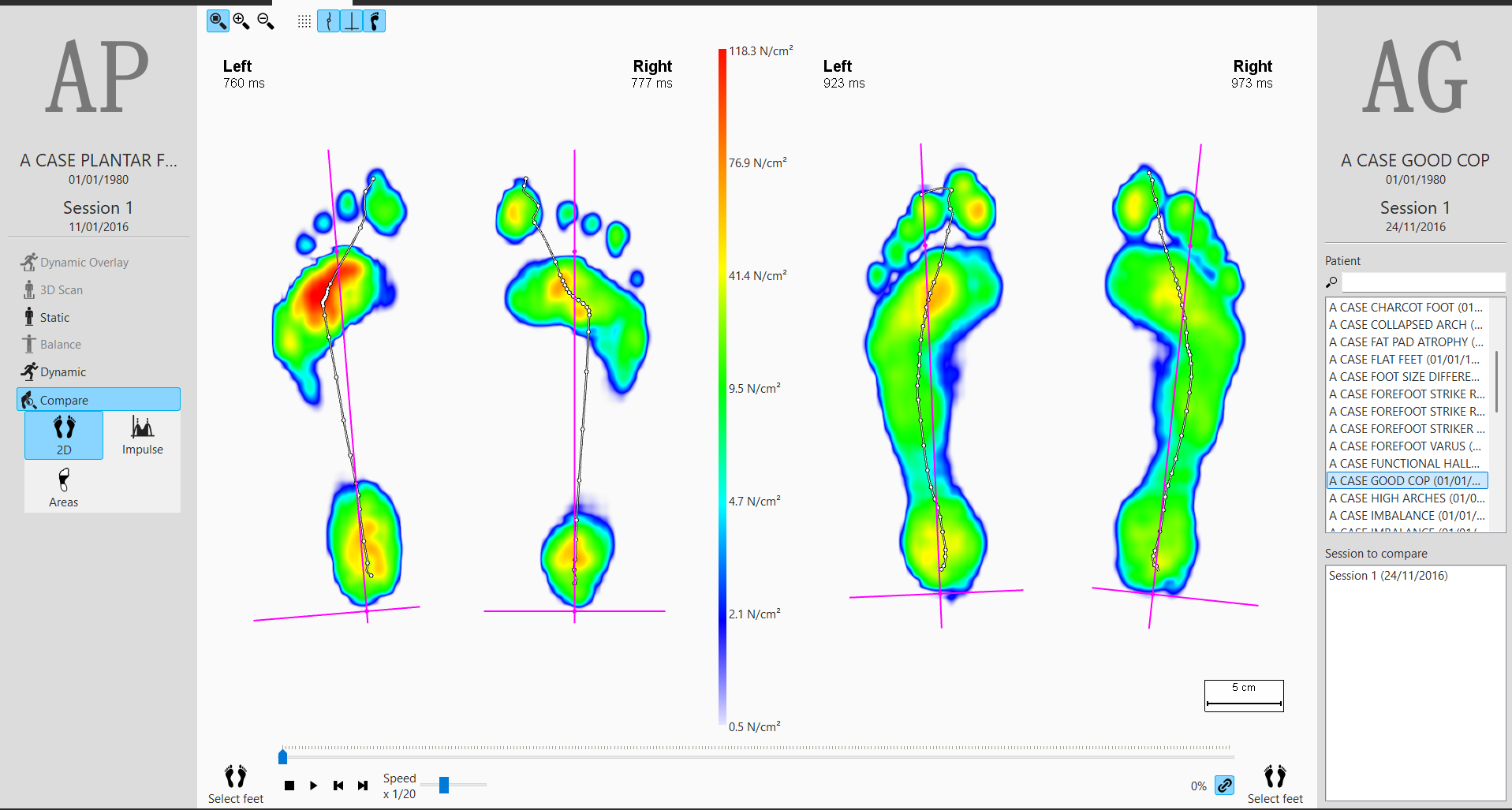
Our footscan software showing a plantar fasciitis patient (left) vs a normal gait (right).
One more useful trick: if we suspect the fascia is being overloaded by the way the foot moves, we'll often tape the foot or pop a temporary heel lift in your shoe and get you to walk. If that eases it straight away, we've learned two things. Changing the load will work, and you've felt for yourself that this can get better.
Giving You The Map
You'll get a written report at your results appointment that sets out what we think is going on, the realistic timeline, and the stages we'll work through. We use the same road map for most conditions:
Foundations. Calm the tissue down, get the ankle and foot moving properly, and take enough load off the fascia that it can start repairing. Hands-on work does most of the heavy lifting here.
Rebuilding. Once the sharp edge has gone, we start loading the fascia and calf deliberately so the tissue remodels stronger. Exercise becomes the main event. Connective tissue takes six to eight weeks minimum to remodel, so this stage needs patience.
Reaching the pinnacle. Building capacity back to whatever your life demands: the marathon, the dog walks, the ten-hour shift. Treatment becomes fine-tuning.
We're honest about timelines. A recent case can turn around in weeks. A heel that's been sore for six months won't be fixed in three visits. And we review regularly, because the first three or four treatments are a trial. If we're not seeing progress by then, we want to know why, and there's usually a reason.
Chiropractic Care
With plantar fasciitis, chiropractic care isn't about your back (though we'll check it). It's about restoring the movement the foot needs so the fascia stops taking the strain. Mike and Yasmin, our two chiropractors, focus on a few specific things.
Getting the ankle bending. The joint between your shin bone and your ankle bone often stiffens up, particularly if the calves have been tight for a long time. Specific mobilisation and adjustment of that joint, plus the joint just below it, restores forward range so the foot no longer has to borrow it by rolling in.
Freeing up the midfoot and big toe. For the windlass mechanism to work, the big toe joint and the small joints across the middle of the foot need to move freely. When they're stiff, the foot can't create spring for push-off and the fascia stays under tension for longer than it should. Mobilising these joints is fiddly but makes a real difference.
Soft-tissue release. The calf, the deep soleus muscle underneath it, and the sole of the foot itself all may get direct hands-on work to reduce the pull on the heel.
Checking the chain above. How your knee, hip and pelvis move affects how your foot lands. The foot rolls you in, the hip rolls you back out, and when the hip isn't doing its share the foot takes the extra. We're careful not to claim every pain starts at the feet, but correcting the foundations often makes everything above move more easily, and the reverse is true too.
Acupuncture & Dry Needling
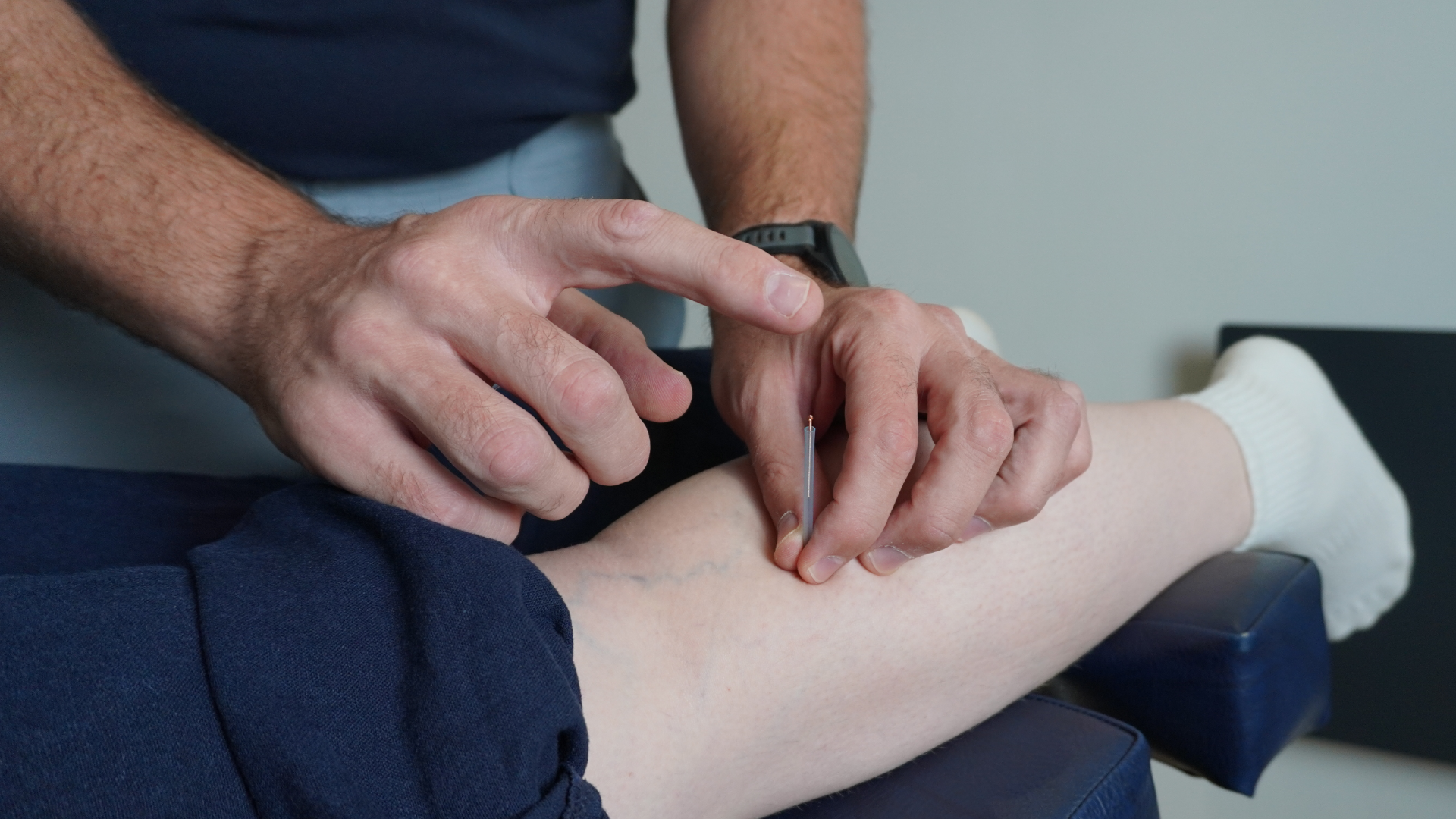
Acupuncture applied to the calf muscles
Alongside the hands-on work, Mike, Yasmin and Hannah all offer acupuncture and dry needling.
Tight, irritable knots in the calf, the soleus and the small muscles in the sole of the foot keep constant tension on the heel and stop the ankle moving freely, however much you stretch. A fine needle into those points can settle them in a way that's hard to match with hands alone. It's not like an injection; most people feel a dull ache and a twitch, and a bit of gym-style soreness the next day. Like everything else here, the aim is to restore proper movement so the tissue can get on with healing.
Sports Therapy And Rehabilitation
This is where Hannah and Abi come in, and it's the part that decides whether your heel pain goes away for good or just quietens down until spring.
Hands-on care calms things down. What actually makes the fascia more resilient is loading it properly. Because the fascia isn't a muscle, we're not "strengthening" it in the usual sense; we're giving it the right stimulus to lay down better-organised, tougher tissue. That happens in stages.
Load management first. Before adding exercise, we sort out the load you're already putting through the foot. That means finding the sweet spot: the amount of walking, standing or running you can do without stirring the heel up for more than a day afterwards. Boom and bust (rest until it stops, overdo it, repeat) is a progress killer.
Strength and flexibility exercises. We’ll progress from static strength through to what we call “heavy slow resistance” which are the gold standard for getting tendon and fascia tissues to repair. Research on this approach shows it outperforms stretching alone in the medium term. We'll show you exactly how.
Then the rest of the leg. Single-leg control, hip and glute strength, and balance work, because a leg that controls itself well from the top puts less strain on the foot. For runners, Hannah runs running assessments and has done the Running Repairs course, so a graded return to running is built in.
Massage And Soft-Tissue Work
Our sports therapists also offer massage and soft-tissue therapy. When your heel has been sore for a while, the calf and the sole of the foot tighten up and guard. Deep work through the calf, the soleus and the plantar surface eases that, improves ankle range, and makes the loading exercises feel a lot more manageable.
The Practical Stuff You Can Do Straight Away
None of this is a substitute for the plan above, but it helps take the load off while the tissue recovers:
Taping. Simple tape across the arch can offload the fascia for a few days at a time and is worth learning.
Retire worn shoes. If your trainers have done more than about 250 miles, they've stopped doing their job.
No sudden jumps. Increase walking, standing or running gradually. Ten to fifteen per cent a week is a reasonable rule.
A quick calf stretch before your first steps. Pulling your toes back towards you before you get out of bed takes the sting out of the morning.
Some people also find a night splint, which holds the ankle bent while you sleep, helps with morning pain. It's not for everyone, and it doesn't fix the underlying load problem, but it's a reasonable thing to try.
What We Deliberately Don't Lead With
"Rest until it stops." It will stop. Then you'll start again with a weaker tissue and it'll come back. Load has to be managed, not removed.
Long courses of anti-inflammatories. Fine for a few days to take the edge off an angry heel. As a plan, they mask the signal you're supposed to be listening to, and in a tissue that's struggling to repair, you want a healing response, not a suppressed one.
Steroid injections as a first move. They can be useful in a genuinely inflamed, recent case. In the long-running, tendon-like cases that make up most of what we see, the benefit is short-lived and repeated injections carry a real risk of weakening the fascia.
Putting It All Together
The point of having all of this under one roof isn't to sell you the whole menu; it means we can pick the two or three things that will help you the most, in the right order, and adjust as you improve.
A typical plan for a straightforward case might be hands-on work to free up the ankle and calf, a heel lift and some taping to take the strain off in the first fortnight, then a progressive loading programme with regular reviews, with Footscan data guiding whether your foot needs more help than that. Someone else's plan might lean more on soft-tissue work and hip strength.
Most heel pain responds well to this approach within a few weeks to months. But some doesn't. If you've been doing all the right things for three to six months and your heel is still grumbling every morning, something else is usually going on, and it's often not in the foot at all. That's for… Part 3.