
How We Treat (Persistent) Plantar Fasciitis
Most plantar fasciitis gets better with the approach we described in our last post: work out what's overloading the fascia, calm it down, load it back up sensibly. But a stubborn minority doesn't. We see these people regularly, and the story is usually the same. Nine months in, sometimes two or three years. They've stretched. They've rolled a frozen bottle under the foot. They've bought the insoles from the chemist, then the expensive ones online. They may have had an injection that helped for six weeks. Every morning, it's still there.
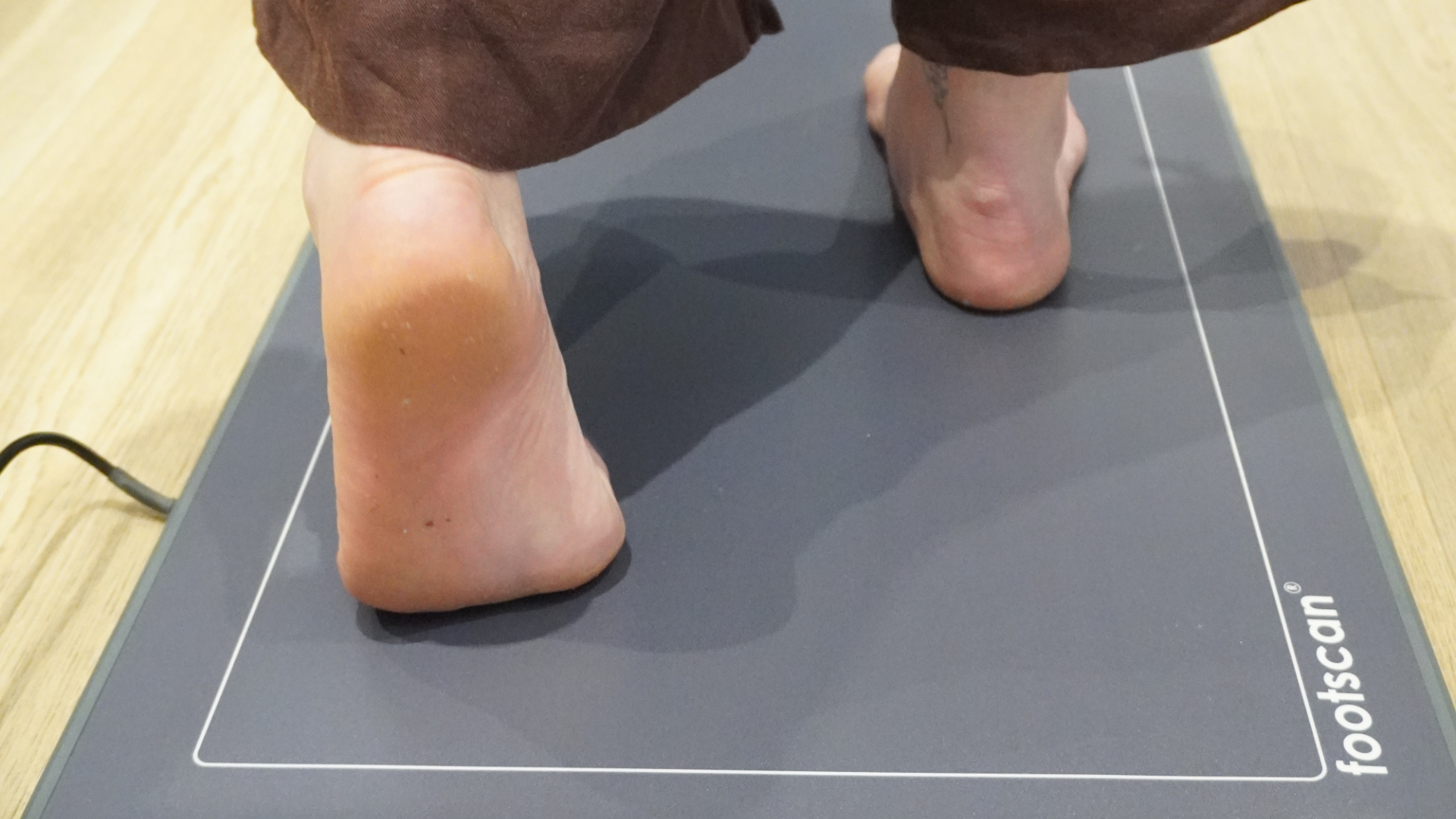
Our footscan process takes 5-10 minutes and gives us unrivalled insight into your gait pattern
If that's you, this post is for you. When heel pain won't shift despite doing the right things, it's rarely because you need more of the same. It's because something is stopping the tissue from healing, and the job is to find out what. That means asking three questions in order.
Question One: Is It Actually The Plantar Fascia?
We always start here, because "stubborn plantar fasciitis" is very often a plan aimed at the wrong target. In our first post we listed the masqueraders, and in the long-running cases three of them come up again and again.
The tibialis posterior tendon, which holds your arch up, is the big one. When it's failing, the arch drops, the fascia gets overloaded as a consequence, and no amount of treating the fascia fixes the cause. Pain and swelling on the inside of the ankle, drifting towards the arch, is the giveaway. A thinned heel fat pad is often layered on top of true fasciitis, and a treatment that helps one can aggravate the other. And in a small number of people, heel pain is the first sign of an inflammatory arthritis that targets the points where tendons and fascia attach to bone. Heel pain in both feet, morning stiffness in several joints for more than half an hour, psoriasis, inflammatory bowel disease or a history of eye inflammation all raise our suspicion, and that's a conversation with your GP or a rheumatologist rather than more hands-on treatment.
If the pattern doesn't add up, an ultrasound scan is a reasonable next step. It shows us whether the fascia is thickened, thinned or partially torn, and each of those changes what we'd do.
Question Two: Why Isn't It Healing?
Assume it really is the fascia, and the local mechanics have been dealt with: ankle moves, calves are looser, you're doing your heel raises. Why is the tissue still stuck?
Every tissue in your body has a capacity, the amount of load it can absorb and repair from. In a straightforward case, the load is too high, we bring it down and build the capacity up, and the two meet in the middle. In stubborn cases, the capacity side of that equation is being held down by something else. Connective tissue heals slowly at the best of times, because it has a poor blood supply. It heals slower still when the body it lives in is running a low-grade inflammatory background, when it's short of the raw materials it needs to make new collagen, or when it's simply exhausted.
There are patterns that make us suspect this. Pain that's out of proportion to what we find when we examine you. Both heels at once, or a heel plus a shoulder plus an elbow. Someone who improves with treatment, plateaus, and then slides back within a fortnight. Poor sleep, low energy and a low mood travelling alongside the pain. Morning stiffness that isn't confined to the foot. None of these prove anything on their own, but together they tell us to look wider than the heel.
Looking Wider: Inflammation, Healing Capacity And Nutrition
I'll say up front that I was wary of this side of things for years. The last thing I wanted was to be the crank chiropractor with a shelf of supplements. What changed my mind was proper training, blood testing, and watching patients who'd been stuck for months finally move once we addressed what was going on underneath. This isn't a replacement for the hands-on work and the loading programme. It's what lets them work.
Low-grade systemic inflammation. This is the same idea we wrote about with persistent sciatica. A slow, background level of inflammation across the whole body, not caused by the heel at all, that leaves sensitive tissues quicker to flare and slower to settle. Plenty of everyday things feed it: a diet heavy in ultra-processed food and sugar, weight carried around the middle, poor sleep, long-term stress, and gut or food-sensitivity problems. In a persistent case, it's often the reason the inflammatory fire keeps smouldering.
Blood sugar and stiff collagen. This one is particularly relevant to the plantar fascia. When blood sugar runs high over time, sugar molecules bond to collagen, and the result is stiff, brittle tissue that's more prone to damage and slower to be replaced. Think of the difference between bread and toast. It's part of why higher body weight and pre-diabetes are so consistently linked to heel pain, and why we take an interest in your blood sugar even if you've never been told there's a problem with it.
Vitamin D. Low vitamin D shifts the immune system towards a more inflammatory state and lowers your pain threshold. In the UK the sun is too weak to make any between October and April, and the large majority of us are low by the end of winter. One of the more striking cases we've written about before was a woman in her thirties with widespread aches, exhaustion, and a history of plantar fasciitis in both feet. Her vitamin D was on the floor. Within weeks of correcting it, the background pain had gone. Not everyone's story is that neat, but low vitamin D is common enough that we check it in almost every stubborn case.
Magnesium and the B vitamins. Both are involved in how muscles relax, how nerves calm down and how you sleep and recover. Magnesium is also needed for vitamin D to work properly. If someone's low, an already irritable system is that much harder to settle.
The building blocks for new tissue. You can't remodel a fascia without the raw materials. Collagen is mostly made of a few amino acids, glycine in particular, and the body needs vitamin C and a couple of minerals to bind it together into strong fibres. Someone eating little protein, or a lot of processed food, may simply not have enough to build with. Where it fits, we'll suggest collagen with vitamin C alongside a protein-rich diet. In terms of timescale, think three months minimum, because that's how long tissue takes to turn over.
Oily fish and natural anti-inflammatories. Omega-3 fats from oily fish help turn down background inflammation. For people who've been taking ibuprofen or naproxen for months, we'll often talk about curcumin (from turmeric) with boswellia as a longer-term option that doesn't carry the same gut and kidney costs.
A word about medication. Some common medicines quietly work against healing. Long courses of anti-inflammatories deplete vitamin B6 and irritate the gut lining. Stomach-acid tablets such as omeprazole block absorption of magnesium and B12. Statins can lower vitamin D and cause muscle aches of their own. Metformin interferes with B12. We are never going to tell you to stop a prescribed medication; that is outside of our scope and potentially dangerous. What we can do is replace what the medication uses up so that your recovery isn't running on empty.
Food sensitivities. In some people with several inflamed tendons, gut symptoms, skin problems or a family history of coeliac disease, a food trial is worth doing. We treat it as a practical two-week experiment, usually gluten or dairy first, followed by deliberately reintroducing the food to see what happens. It's not a belief system and it's not forever. It's a test.
Testing Rather Than Guessing
We offer blood testing through Optimal Testing, with the sample taken locally and the results reviewed here. For stubborn heel pain, the markers we care about most are vitamin D, magnesium, B12 and folate, ferritin (iron stores), CRP (a general inflammation marker) and HbA1c (your three-month blood sugar average).
We don't push testing on everyone. For most patients, sensible food advice and a couple of foundations are plenty. But if you've been stuck for months, it turns "let's try some supplements" into "here's exactly what's low, and here's what we're targeting".
Shockwave Therapy
For fascia that's simply stopped repairing, shockwave is the most powerful tool we have, and chronic plantar fasciitis is the condition it's been studied on most.
Shockwave uses acoustic pressure waves delivered through a handpiece pressed against the heel. Each pulse creates a tiny, controlled stimulus in the tissue. That increases blood flow, triggers a fresh, short-lived healing response (the good kind of inflammation), and essentially wakes up tissue that has given up on repairing itself. Think of it as jump-starting a stalled engine. It feels like firm, rapid tapping. Over a tender heel it can be extremeley uncomfortable, but sessions are short (ten to fifteen minutes) and we adjust the intensity to you.
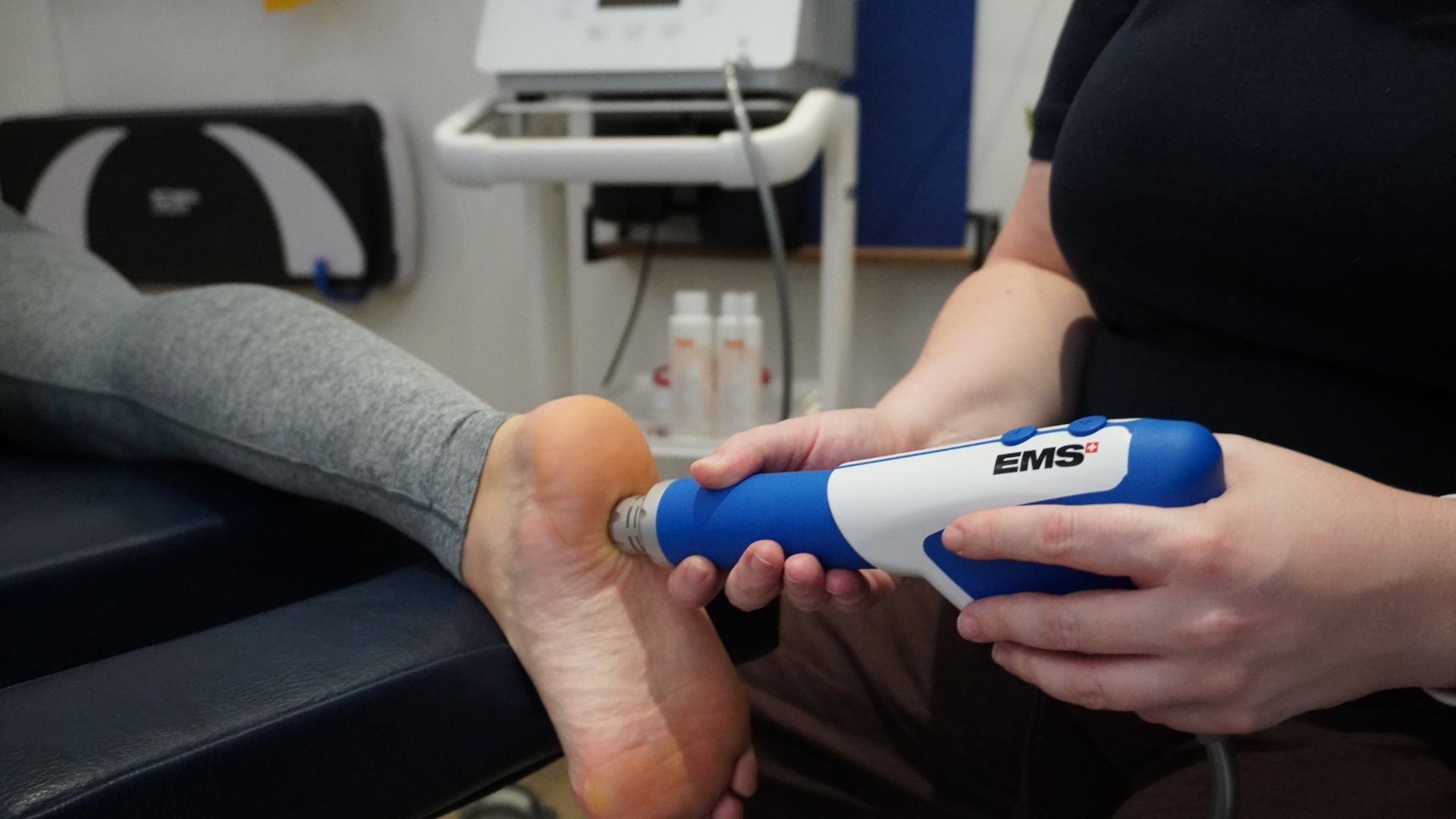
Shockwave is a breakthrough therapy for persistent Plantar Fasciitis
We use the EMS Swiss DolorClast, the machine behind most of the published research on this type of shockwave. A course is usually six to twelve weekly sessions. Many people notice a change after two or three, and the full effect keeps developing for several weeks after the course finishes, because what we've started is a healing process rather than a numbing one. For the same reason, we ask you to avoid anti-inflammatory tablets straight after a session. It works best on heel pain that's been present for more than six weeks and hasn't responded to the basics, including people who've already had an injection.
Two notes on Shockwave Therapy. First, shockwave is a stimulus, not a fix on its own. Tissue that's been kick-started still needs the loading programme to turn that stimulus into stronger fascia, and it still needs the mechanical overload addressed, or it breaks down again. Second, it isn't suitable for everyone. We don't use it in pregnancy, over an active infection or a tumour, in people with clotting disorders or on blood thinners, or with a pacemaker. We'll screen for all of that before we start.
Footscan And Phits Custom Insoles
If the way your foot moves is a big part of the overload, and in stubborn cases it usually is, then changing the ground the foot lands on can be the piece that finally lets the fascia rest.
The trouble with most insoles for plantar fasciitis is that they're built to a shape, not to a movement, and the shape pushes up under the arch and heel. That's exactly where it hurts. It's why so many people tell us they've got a drawer full of insoles that made no difference or made things worse. Every packet says "good for plantar fasciitis". Almost none of them are designed around how your particular foot loads.
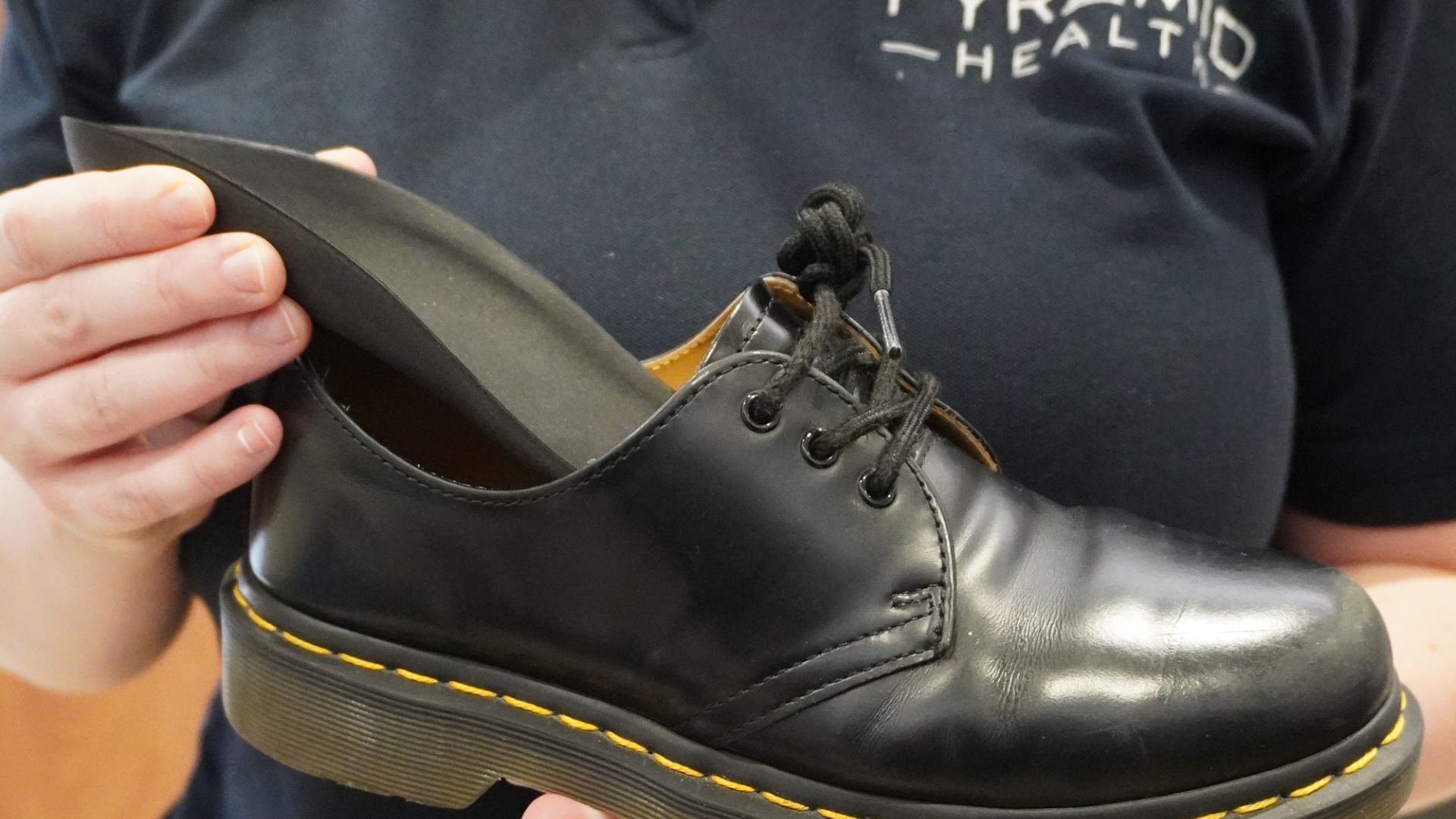
Phits insoles are designed entirely around your personal dynamics
Phits insoles are different in two ways that are crucial for heel pain. First, they're designed from your Footscan data, so the prescription is based on how your foot actually moves through a step, not a static mould or a footprint. Second, because they're 3D printed, the shell can be stiff in one area and flexible in another. That lets us control the heel and the joint beneath the ankle, which is where the rolling-in happens, while softening the section directly under the sore attachment point so the insole is supporting the arch without pressing on the painful bit. A shock-absorbing top layer that stiffens on impact takes the edge off heel strike, and a small heel raise can be built in where it helps.
For plantar fasciitis, insoles are usually a temporary tool. The plan is to do your rehab while wearing them, so the tissue adapts to the corrected position, then gradually wear them less as your own capacity comes back. They take around a week to make and a week or two to get used to, and we re-scan you afterwards so you can see the change in how you load, rather than take our word for it.
Putting The Pieces Together
A stubborn case rarely has one answer. It usually has three or four partial ones that only work together. A plan for someone who's been stuck for a year might look something like this over three months:
Weeks 1 to 2. Re-assess properly, including the ankle, tib post and heel pad; Footscan; bloods drawn. Hands-on work to restore ankle and midfoot movement. Taping and a heel lift to buy the fascia some breathing space. Start isometric loading.
Weeks 2 to 8. Phits insoles fitted. Weekly shockwave to restart the repair. Progressive heel-raise loading and calf work done on the insoles. Blood results back; correct vitamin D and anything else that's low, sort out the diet basics, and start collagen if it fits. Sleep and stress addressed, because they matter more than most people expect.
Weeks 8 to 12. Shockwave finishes; loading increases towards single-leg and weighted work; graded return to running or long shifts. Review, re-scan, and decide what maintenance looks like.
Not everyone needs every piece. Someone with pristine bloods and a heavily pronating foot needs the insoles and the shockwave. Someone with normal mechanics and a vitamin D level in their boots needs the opposite. The assessment tells us which.
When It Needs Someone Else
We'll always be straight with you. If the pattern suggests an inflammatory arthritis, a nerve problem, or a tear, you need a GP, a rheumatologist, a podiatrist or a scan, and we'll help you get there rather than keep you on the treatment table. In a genuinely inflamed, recent flare, a steroid injection has its place, and we'll say so. Knowing when not to keep treating is part of doing this properly.
If This Sounds Like You
If you've had heel pain for months, tried the sensible things and it's still ruining your mornings, don't assume that's just how it is now. Come and let us look at the whole picture. Call us on 01395 911493 or book online.