
Why We Don’t Take Chances With Vitamin B12 Deficiency
You may have already read on this blog that there's been a few changes at Pyramid Health over the last couple of years. We've been looking more closely at clinical nutrition, running blood work, and asking questions that go beyond the standard musculoskeletal stuff.
B12 is one of the biggest reasons why.
This week, a coroner's report made national news. A 21-year-old vegan university student, Georgina Owen, tragically took her own life after developing delusions — likely linked to undiagnosed B12 deficiency according to the coroner. It's devastating, and it didn't need to happen.
I'm sharing this because it highlights something we come up against in clinic all the time. We tell patients that their B12 might be an issue. We tell them their GP probably won't flag it. And honestly? Most of them don't believe us. They assume that if something was wrong, their doctor would have picked it up. I would invite anyone to watch Jimmy’s story below - his is not an uncommon one in our experience.
The Grey Zone Your GP Probably Isn't Telling You About
The NHS cut-off for B12 deficiency is around 180 ng/L. If your result comes back above that, you'll get a text or a letter saying everything's normal.
But NICE — the body that writes the guidelines GPs are supposed to follow — actually acknowledges a "grey zone" of 180–350 ng/L. Their guidance says that if a patient has suggestive symptoms and falls in this range, a trial of B12 therapy should be considered. That's been in the guidance for years.
In our experience, a lot of GPs don’t adhere to it. Patients in the grey zone are routinely told their B12 is "normal" and sent home. But the consequences of missing this include irreversible nerve damage, and the guidance explicitly tells clinicians to act.
B12 - Not Just Anaemia
The NHS is mostly interested in B12 in relation to anaemia. But anaemia is a late-stage feature — and folic acid (which is added to most bread and cereals these days) can mask it entirely. So someone can have genuinely low B12, a perfectly normal-looking blood count, and still be deteriorating underneath.
What's actually happening when B12 levels drop? Two things.
First, your energy production nosedives. B12 is essential for a key step in how your cells generate energy. When it stalls, you develop fatigue. Mild at first, but it can become all-encompassing — and it doesn't improve with sleep. This happens long before anaemia shows up, and it's one of the most commonly misdiagnosed presentations out there. It often just gets labelled as depression.
Second — and this is the one that causes the wide-ranging variety of symptoms — B12 drives methylation, which is how your body regulates neurotransmitters, builds myelin (the insulation around your nerves), and makes new DNA. When methylation slows down, the effects are significant: mood changes, anxiety, depression, brain fog, lowered pain thresholds, tingling, numbness. In severe cases, psychosis and delusions.
This isn't fringe stuff. NICE lists neuropsychiatric symptoms as a recognised feature of B12 deficiency. Published research shows psychiatric symptoms can occur at levels many would consider "normal," and that psychosis can respond to B12 replacement even after prolonged deficiency.
What We Do Differently
If a patient has suggestive symptoms and a B12 under 677 ng/L, we're going to recommend a trial. That's well above the NHS cut-off. Why that high? Because research on healthy elderly volunteers with B12 levels around 562 ng/L — comfortably "normal" — found early signs of brain changes on MRI consistent with evolving cognitive decline. People well above the cut-off, already showing damage.
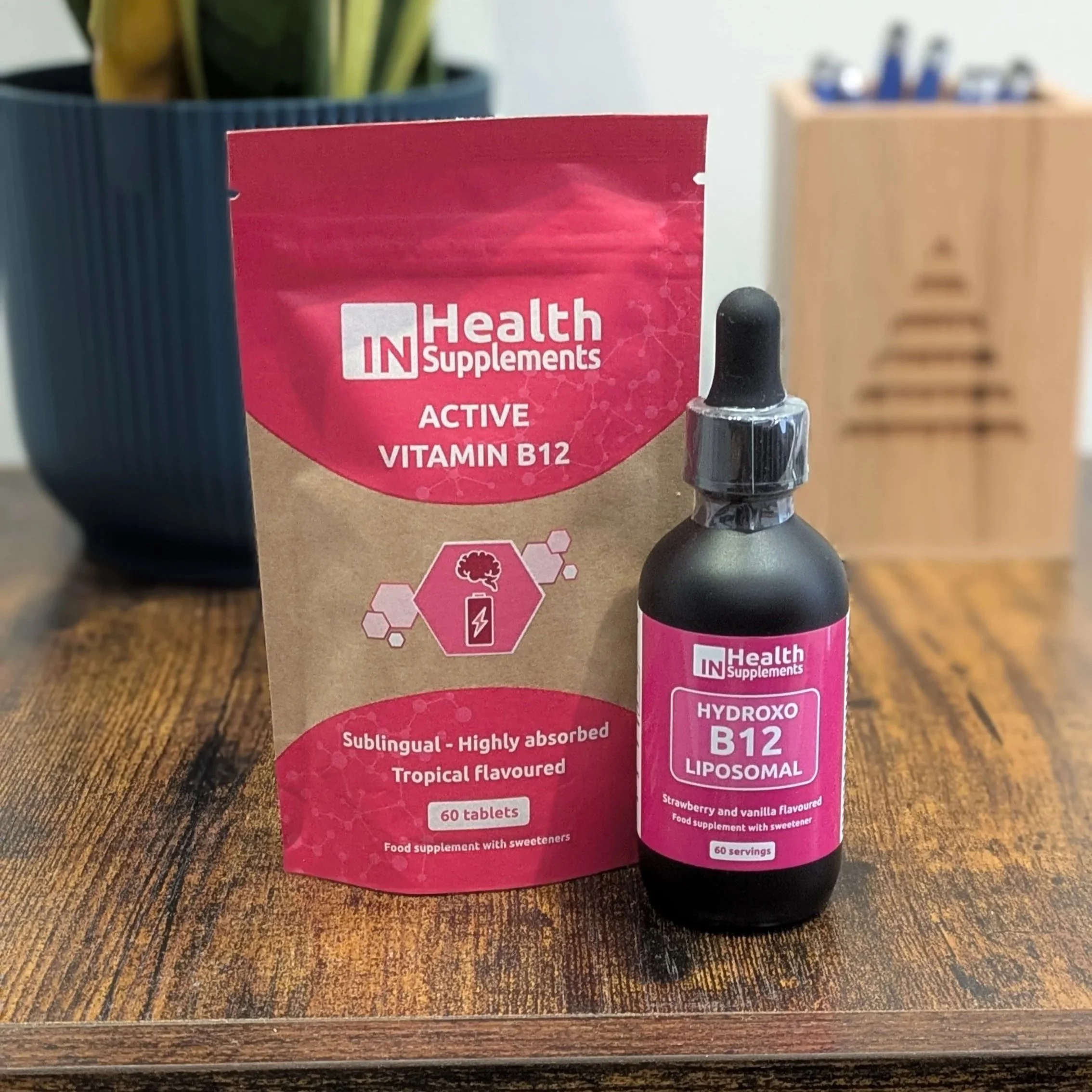
We use liposomal hydroxocobalamin (the same form as NHS injections, but in a delivery that bypasses absorption issues) alongside supporting B vitamins. We never use cyanocobalamin — that's the inactive form found in most supermarket supplements. If you're taking B12 from Boots or Holland & Barrett, check the label. If it says cyanocobalamin, it's not doing much.
Why Might Your B12 Be Low?
The most common reasons: ultra-processed diets (surprisingly low in B12), vegan diets without proper supplementation, and absorption problems. You need stomach acid, intrinsic factor, and a healthy gut to absorb B12. Anything that disrupts that chain — PPIs like omeprazole, metformin, coeliac disease, IBS, Crohn's, or just getting older — can quietly erode your levels over months and years.
If you're on metformin for type 2 diabetes and feeling increasingly tired, low, or experiencing tingling, please get your B12 checked properly.
Check Your Own Results
You can request your actual B12 number through the NHS app rather than just accepting "normal." If you're in that grey zone (180–350 ng/L) and you have symptoms, that warrants further investigation — regardless of what the text message said. And if your GP has told you it's fine, respectfully, get a second opinion.
We can also arrange comprehensive blood panels through Optimal Testing if you want a proper look.
The Bottom Line
We know this can sound like we're overstepping. We know it's a big thing to hear that your GP might have missed something. But the guidance is there in black and white — NICE has defined the grey zone, they've said to trial therapy when symptoms are present, and in practice it's being missed routinely.
If you're coming to us with persistent pain, fatigue, brain fog, mood changes, or neurological symptoms that aren't resolving — we're going to ask about your B12. And if there's even a reasonable suspicion, we're going to recommend a trial, because the risk of doing nothing is far greater than the risk of trying.
And if any of this sounds familiar — come and talk to us. Testing doesn't lie, but it doesn't always tell the whole truth either.
Ready to get your levels checked? Book a consultation at Pyramid Health. Call us on 01395 911493 or book online.